


🐾 Parent Guide: This article is part of our comprehensive Dog Health & Wellness: Complete Owner’s Guide, where you can find expert advice and tips.
Labradors are the quintessential family dog — friendly, food-motivated, endlessly forgiving, and statistically one of the most popular breeds on the planet for decades running. They are also one of the most overfed and under-exercised dogs in veterinary waiting rooms, and that gap between their natural vitality and modern ownership realities drives a significant share of their health problems.
Labs are not a fragile breed. With good nutrition, maintained body weight, and regular vet monitoring, many live 12 to 14 healthy years. But several inherited and lifestyle-driven conditions deserve every owner’s attention from puppyhood onward.
How Long Do Labrador Retrievers Live?

The average Labrador lifespan is 10 to 14 years, with chocolate Labs statistically trending slightly shorter (around 10.7 years) compared to black and yellow Labs (around 12.1 years) — a difference researchers have linked to the genetic narrowing associated with the chocolate coat colour gene. Well-bred, healthy-weight Labs regularly reach 13 to 14 years.
The Most Common Labrador Retriever Health Problems
1. Obesity — The Most Preventable Labrador Health Problem

Obesity is the single most common and most damaging health issue in Labradors, and it is almost entirely preventable. Labs carry a well-documented genetic variant in the POMC gene (pro-opiomelanocortin) that impairs the feeling of fullness — in plain terms, many Labs are genetically wired to feel perpetually hungry regardless of how much they have eaten. Studies suggest this variant is present in approximately 25% of the Labrador population and is particularly prevalent in working and assistance dogs.
The consequences of obesity compound every other health condition: it accelerates joint degeneration, worsens breathing, strains the cardiovascular system, and increases cancer risk. A Labrador maintained at a lean body condition score throughout life lives statistically longer than an overweight one.
Practical management: measure food portions using a kitchen scale rather than guessing by eye, use a slow feeder bowl, replace high-calorie treats with low-calorie alternatives (plain cucumber, carrot, blueberries), and resist the persuasive lobbying your Lab will conduct at every mealtime.
2. Hip and Elbow Dysplasia

Hip and elbow dysplasia are both well-documented in Labradors, driven by a combination of genetics and growth-rate factors. Both conditions involve abnormal joint development causing progressive cartilage loss, pain, and arthritis.
OFA certification and PennHIP scoring are the two main evaluation methods used by responsible breeders. A PennHIP score below 0.30 distraction index is considered low risk. For managing joint health long-term — including the best supplements and low-impact exercise protocols — see our Dog Joint Health Guide.
Signs: stiffness after rest, reluctance to climb stairs or jump into the car, bunny-hopping in the rear legs (hip dysplasia), front leg lameness or one elbow visibly turned outward (elbow dysplasia).
3. Exercise-Induced Collapse (EIC)

Exercise-Induced Collapse is a genetic condition specific to Labradors (and a small number of related retrievers) in which intense exercise triggers sudden loss of hind limb coordination and collapse. Episodes typically occur 5 to 15 minutes into intense activity. The dog remains conscious and usually recovers within 15 to 30 minutes with rest, though repeated severe episodes can occasionally be fatal.
EIC is caused by a recessive mutation in the DNM1 gene and is identifiable through DNA testing. A dog must inherit two copies of the mutation (homozygous affected) to show clinical signs; carriers (one copy) are unaffected. DNA testing through Embark or the Orthopedic Foundation for Animals identifies carrier, clear, and affected status. Affected Labs can live full, happy lives with activity management — avoiding intense, sustained exercise.
4. Progressive Retinal Atrophy (PRA)
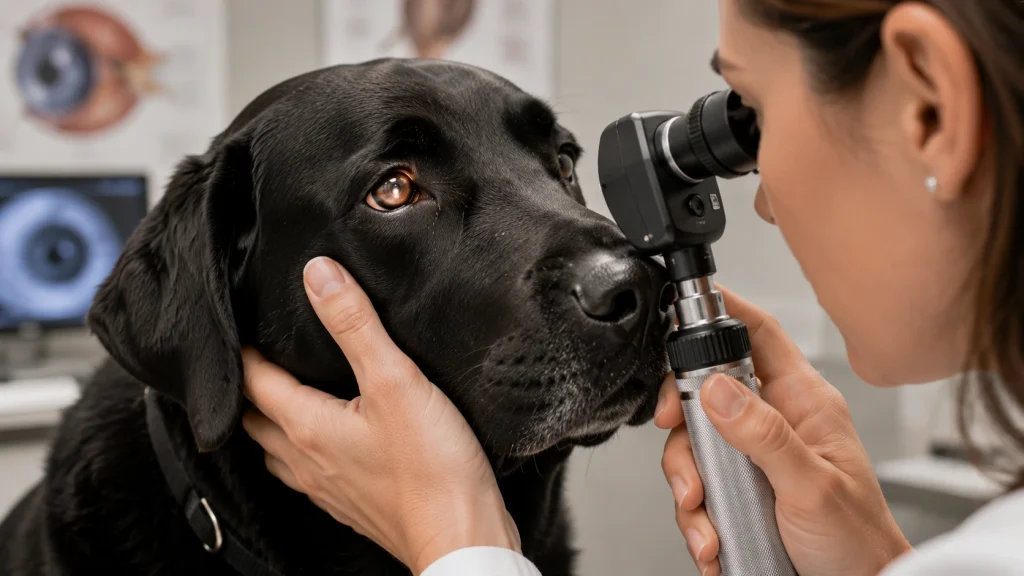
Progressive Retinal Atrophy is an inherited eye condition causing gradual degeneration of the retinal photoreceptors, leading first to night blindness and eventually to complete vision loss. Labradors carry two forms: prcd-PRA (progressive rod-cone degeneration) and PRA-D (a more recently identified form). Both are autosomal recessive and identifiable through DNA testing.
Annual CAER (Companion Animal Eye Registry) examinations and DNA testing are the standard screening tools used by responsible breeders. For a comprehensive guide to canine eye conditions, see our Dog Eye Health Issues guide.
5. Centronuclear Myopathy (CNM)
CNM is a rare but serious inherited muscle disease unique to Labradors, causing progressive muscle weakness from early puppyhood. Affected puppies show muscle wasting, exercise intolerance, difficulty swallowing, and an abnormal gait. There is no treatment. DNA testing identifies affected dogs and carriers, and responsible breeders screen for it routinely.
6. Bloat (GDV)
As a deep-chested, large breed, Labradors carry a moderate risk of gastric dilatation-volvulus (GDV) — a life-threatening emergency in which the stomach fills with gas and twists. See the GDV section in our Bernese Mountain Dog Health Issues article for the full emergency protocol, as the warning signs and first-response actions are the same across all large breeds.
7. Skin Conditions and Allergies

Labradors are among the breeds most commonly diagnosed with environmental and food allergies. Skin-related symptoms — chronic itching, recurring ear infections, paw licking, hot spots, and recurrent skin infections — are often the presenting signs of an underlying allergy.
Management: identification of the trigger (through elimination diets for food allergies or allergy testing for environmental triggers), regular ear cleaning, omega-3 supplementation for skin barrier support, and in persistent cases, veterinary prescription therapy.
Warning Signs Every Labrador Owner Should Know
Seek vet attention promptly for:
- Rapid weight gain despite no increase in food
- Any lameness, stiffness, or reluctance to exercise
- Collapse or hind leg weakness during or after exercise
- Night blindness or bumping into objects in low light
- Recurrent ear infections (more than 2 per year)
- Chronic paw licking, belly rashes, or hot spots
- Swollen abdomen, unproductive retching, or distress — emergency: call the vet immediately
- Any new lumps — Labs have elevated mast cell tumour risk too
Labrador Breeder Health Screening Checklist
| Test | Standard |
|---|---|
| OFA Hip Evaluation | Excellent, Good, or Fair at ≥2 years; or PennHIP distraction index |
| OFA Elbow Evaluation | Normal at ≥2 years |
| CAER Eye Examination | Annual, by board-certified ophthalmologist |
| DNA: Exercise-Induced Collapse (EIC) | Clear or Carrier (no Affected/Affected breeding) |
| DNA: Progressive Retinal Atrophy (prcd-PRA & PRA-D) | Clear or Carrier |
| DNA: Centronuclear Myopathy (CNM) | Clear or Carrier |
Frequently Asked Questions
What is the most common health problem in Labradors?
Obesity is statistically the most prevalent — and most consequential — health problem in Labradors, driven partly by a genetic variant that blunts the sensation of fullness. It compounds every other condition the breed faces.
Do chocolate Labs have more health problems?
Research suggests chocolate Labradors have a slightly shorter average lifespan and higher rates of ear infections and skin conditions, likely connected to the selective breeding pressure around the chocolate colour gene rather than the coat colour itself.
Can Labradors live to 14 years?
Yes — well-bred, healthy-weight Labradors maintained at lean body condition with regular vet care regularly live 13 to 14 years. Weight management is the single most impactful longevity factor within an owner’s control.