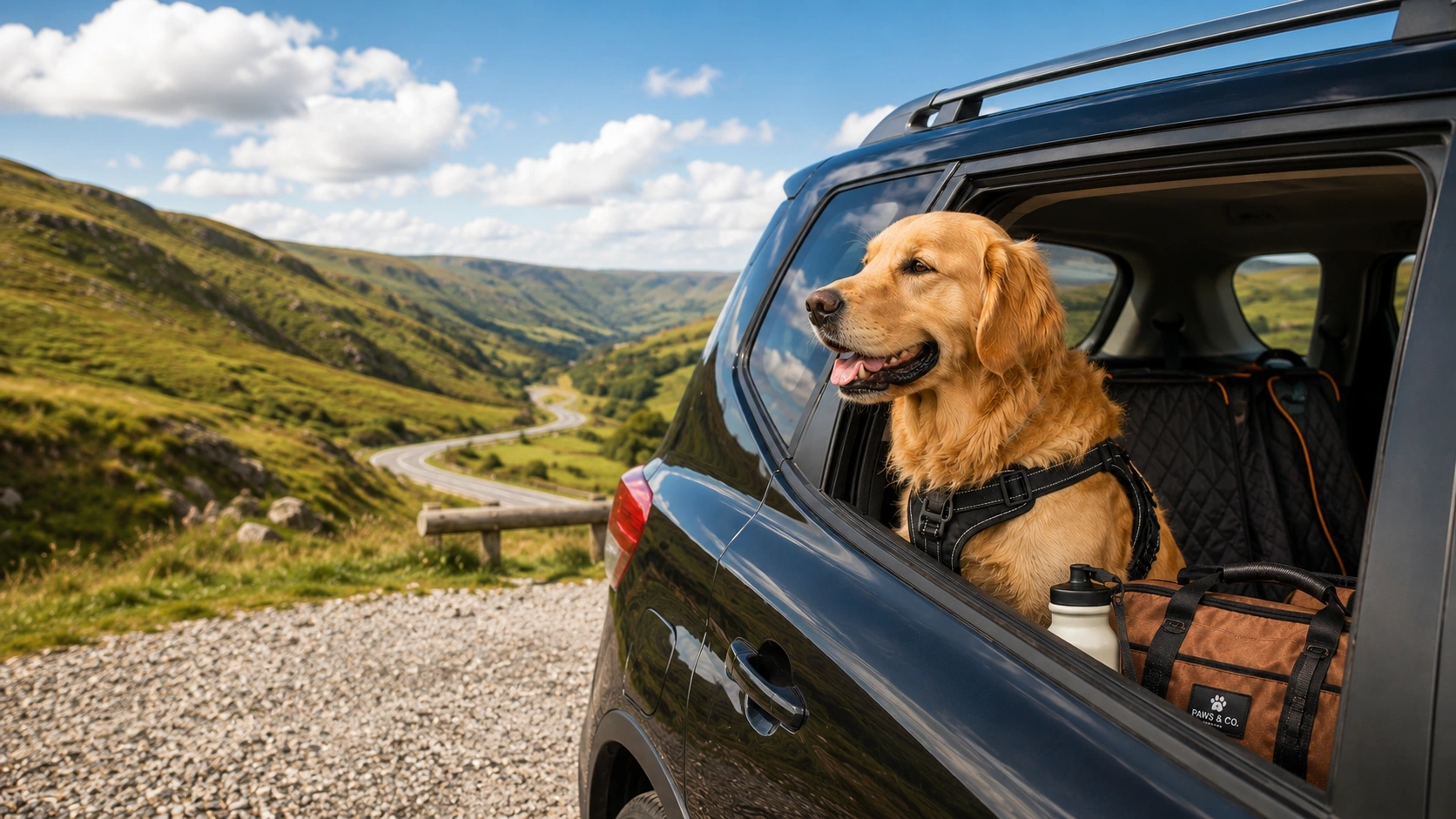
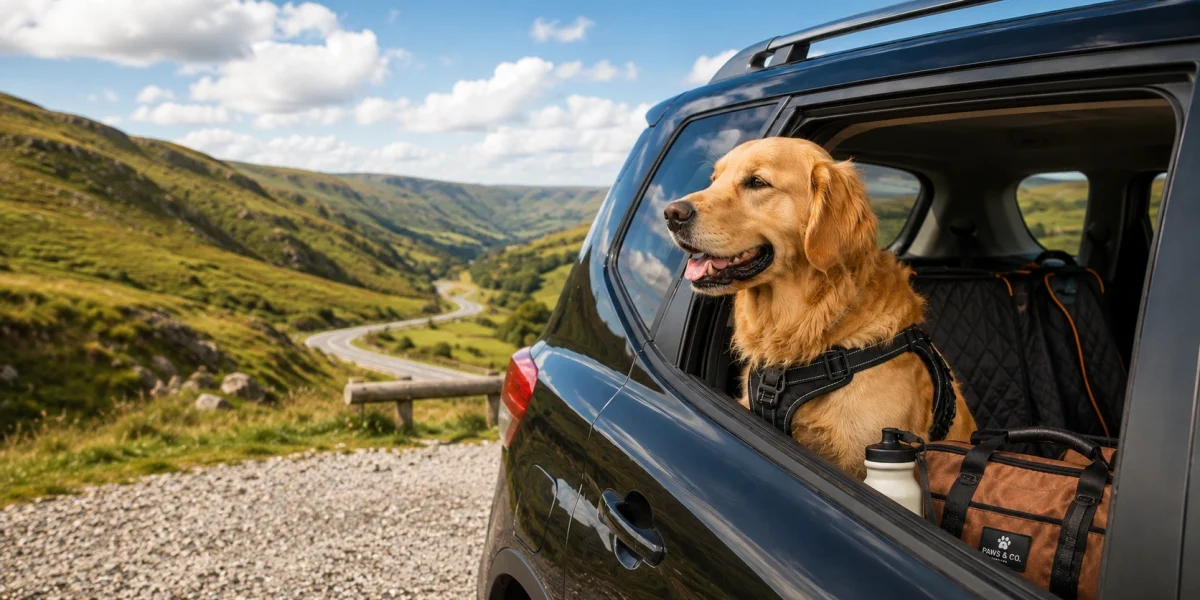
Travelling by car with your dog should be fun — not stressful, dangerous, or covered in fur. But without the right gear, even a short trip to the vet can go sideways fast. A loose dog in a moving vehicle is a genuine safety risk: in a 30 mph crash, an unrestrained 25 kg dog generates a force equivalent to over 500 kg of impact. That’s not just dangerous for your dog — it’s dangerous for everyone in the car.
This complete dog car travel guide covers everything you need to know: how to choose the right dog car harness, which seat covers actually hold up, what to do if your dog gets car sick, how to help senior dogs in and out of high vehicles, and exactly what to pack for a long road trip. Every recommendation here is grounded in safety data and real owner experience.
Whether you’re making a 10-minute vet run or a 6-hour road trip, this guide has you covered from buckle to boot.
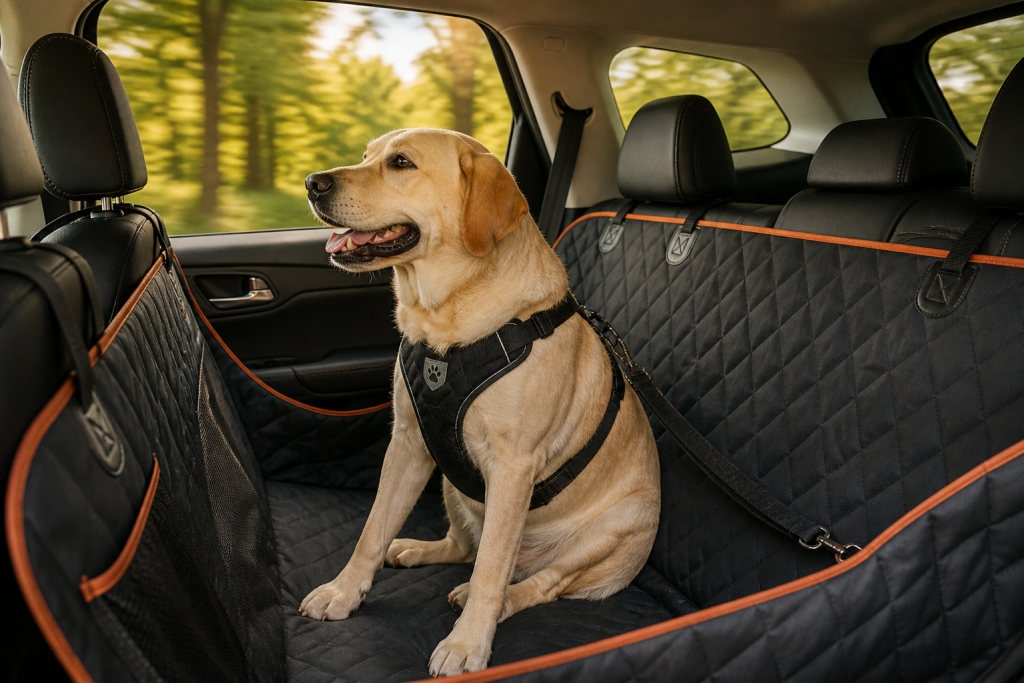
Why Dog Car Safety Is More Serious Than Most Owners Realise
Most dog owners know they should restrain their dog in the car. Far fewer actually do it consistently — and even fewer do it correctly.
In many countries, driving with an unrestrained dog is a legal offence. In the UK, Highway Code Rule 57 states that dogs must be “suitably restrained so they cannot distract the driver or injure themselves or others.” In the US, laws vary by state — New Jersey, for example, explicitly requires pet restraints in moving vehicles.
Beyond legality, the physics are sobering. A crash at just 30 mph multiplies your dog’s body weight by a factor of around 20. An unrestrained dog also becomes a projectile that can critically injure other passengers. According to the AAA Foundation for Traffic Safety, 65% of dog owners admit to driving while distracted by their dog.
The three most common mistakes dog owners make in the car:
- Using a regular walking harness clipped to a seatbelt (not crash-rated — most collapse on impact)
- Letting small dogs sit in the front seat or on a lap
- Using a crate without securing it to the car floor or boot anchors
The good news: fixing all three is straightforward once you know what to look for.
Choosing the Right Dog Car Harness (The Most Important Decision You’ll Make)
The dog car harness is the foundation of car safety. Not all harnesses are equal in fact, the majority of harnesses sold as “car safe” have never been crash-tested.
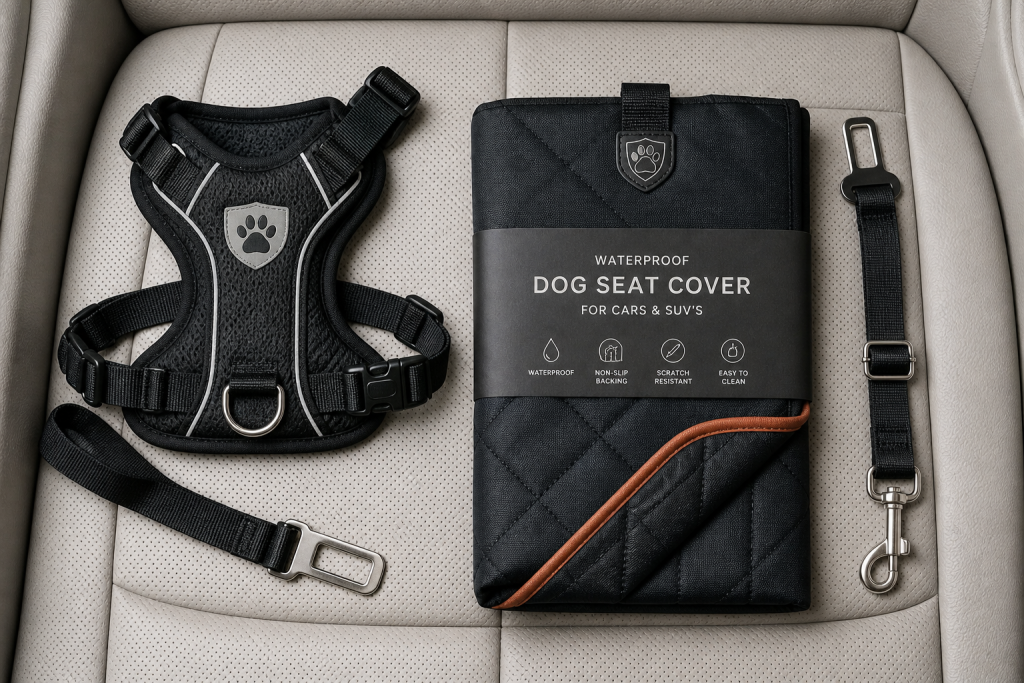
What “Crash-Tested” Actually Means
Genuine crash-tested harnesses are certified to standards like the Center for Pet Safety (CPS) in the US or TÜV in Europe. These tests simulate real collision forces and measure whether the harness holds, whether the attachment points fail, and whether the dog’s body is protected from impact.
Look for these certifications before buying anything:
- CPS Certified (Centre for Pet Safety — USA)
- TÜV GS Mark (Germany — rigorous independent testing)
- UTAC CERAM (France)
Which Is Right for Your Dog?
| Type | Best For | Pros | Cons |
|---|---|---|---|
| Crash-tested chest harness | All dogs, safety-first | Highest protection, distributes force away from neck | More expensive ($40–$120) |
| Standard harness + seatbelt clip | Short trips, calm dogs | Affordable, easy to use | Most NOT crash-rated — check before buying |
| Car seat (small dogs) | Dogs under 9 kg | Extra cushioning, harness built in | Only suitable for small breeds |
| Travel crate (secured) | Dogs uncomfortable in harnesses | Familiar space, good for anxious dogs | Must be bolted down — loose crates are dangerous |
| Dog car barrier | Large dogs, boot travel | Keeps dog separate from cabin | Doesn’t protect dog in collision |
Our recommendation: For medium to large dogs, a CPS-certified harness like the Sleepypod Clickit Sport or Kurgo Tru-Fit is the gold standard. For small dogs, look at crash-tested booster seats with integrated harnesses.
💡 Quick Tip: Always connect the harness seatbelt clip to your car’s rear seatbelt buckle — not the top-tether anchor, which is designed for child seats and rated differently.
→ See our full breakdown: Best Dog Car Harness — Crash-Tested Rankings
Dog Car Seat Covers: Protecting Your Car Without Sacrificing Comfort
A quality dog car seat cover does three jobs at once: protects your upholstery from mud and scratches, keeps your dog from sliding around, and makes clean-up dramatically faster.
Hammock vs. Bench Cover vs. Boot Liner
Hammock covers are the most popular option for back-seat dogs. They stretch between the front and back headrests, forming a sling that prevents your dog falling into the footwell — especially useful during braking.
Standard bench covers sit flat across the back seat and work better for dogs that like to sit upright and look out the window.
Boot liners are the right choice for large dogs travelling in the boot/trunk. Look for non-slip backing and waterproof materials.
What to look for in any seat cover:
- 600D or higher Oxford fabric (water-resistant and scratch-resistant)
- Non-slip underside (critical — a sliding cover defeats the purpose)
- Mesh side windows so your dog can see and you can check on them
- Compatible with seatbelt access slots (so you can still use the harness properly)
- Machine washable
→ Full roundup: Best Dog Car Seat Covers — Tested & Ranked
Dog Ramps and Steps for Cars: A Must for Senior and Large Breed Dogs
If your dog is a large breed, a senior dog, or recovering from joint surgery, jumping in and out of a raised vehicle — an SUV, truck, or 4×4 — puts enormous stress on their joints every single time.
A dog ramp for car eliminates that repeated impact. Over months and years, this makes a meaningful difference to hip and joint health, particularly for breeds prone to hip dysplasia (German Shepherds, Labs, Golden Retrievers) or arthritis.
Ramp vs. Steps: Which Is Better?
Ramps are better for dogs with mobility limitations — the incline is gentler and requires less individual leg effort. They work well for large dogs and seniors.
Steps are more compact and easier to store. Better for smaller, agile dogs who just need a boost.
Key specs to check before buying a ramp:
- Weight capacity: Must comfortably exceed your dog’s weight by at least 20%
- Surface traction: Textured or carpeted surface prevents slipping
- Length: Longer ramp = lower angle = easier climb. Minimum 100 cm for most SUVs
- Stability: Wide base and rubber feet prevent wobbling when dog is on it
- Foldability: Telescoping or bi-fold designs fit in most car boots
→ Full guide: Best Dog Ramps for Cars — SUV, Truck & Hatchback Options
Dog Car Sickness: Why It Happens and How to Fix It
Car sickness is one of the most common travel problems dog owners face — and one of the most misunderstood. Many owners assume their dog just “hates the car,” when the root cause is often physiological, not psychological.
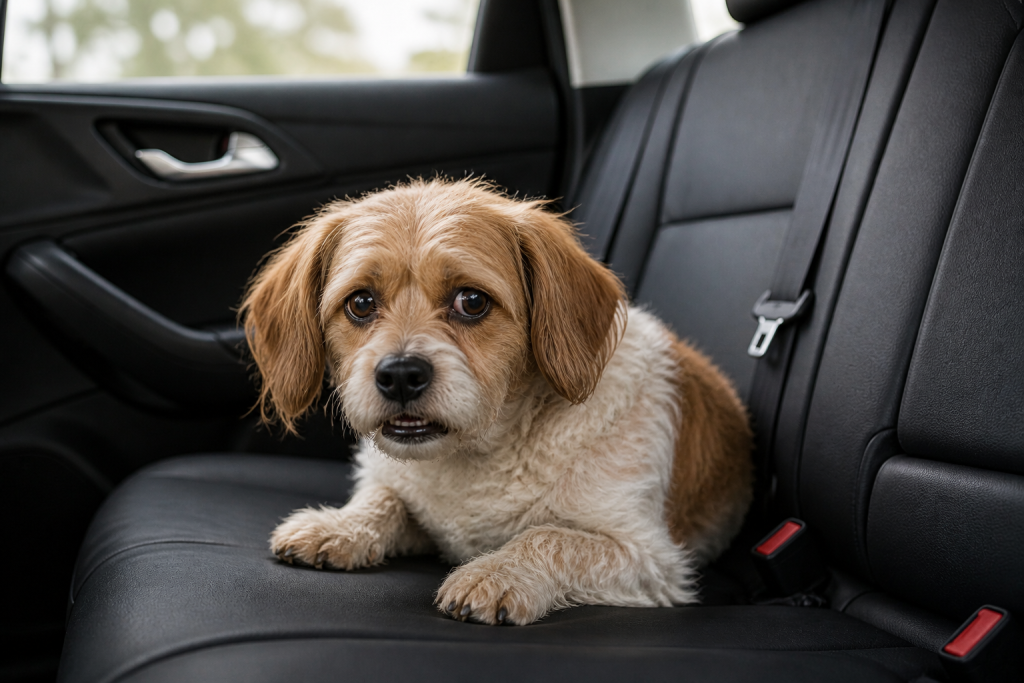
Signs your dog has car sickness:
- Excessive yawning or lip-licking
- Drooling more than usual
- Whining or restlessness
- Vomiting or retching
- Refusing to get in the car
Dogs (especially puppies) experience motion sickness because their inner ear is still developing — the same reason children often grow out of it. In adult dogs, it can also be anxiety-driven, particularly if the car has historically meant stressful destinations (vet, kennel).
Practical Solutions — From Simplest to Medical
Position adjustments (try first):
- Face your dog forward — rear-facing travel makes motion sickness worse
- Lower the window 5–10 cm for fresh air and to equalise air pressure
- Cover the crate or use a calming cover to reduce visual stimulation
- Stop every 90 minutes on long trips for fresh air and water
Behavioural desensitisation (for anxiety-driven sickness):
- Start with just sitting in the parked car with treats
- Progress to short 2-minute drives to neutral destinations
- Build positive associations gradually over 2–4 weeks
Supplements and remedies:
- Ginger treats or ginger capsules — natural anti-nausea, safe for most dogs
- Adaptil spray on a travel blanket — synthetic dog-calming pheromone
- Rescue Remedy for Pets — Bach flower-based, widely used
Prescription options (for severe cases):
- Cerenia (Maropitant) — the only FDA-approved anti-nausea medication for dogs, given 2 hours before travel. Prescription only — ask your vet.
→ Deep dive: Dogs and Car Sickness — Causes, Remedies & When to See a Vet
How to Get Dog Hair Out of Your Car (Faster Than You Think)
If you travel regularly with a shedding dog, dog hair in the car is a constant battle. These are the methods that actually work:
Rubber gloves: Dampen a rubber glove and run it across fabric seats — static pulls hair into clumps that you can lift off easily. Cheapest and most effective method.
Squeegee: A rubber-bladed window squeegee does the same job on upholstery — drag it across the surface and hair balls up for easy removal.
Fabric softener spray: Mix one part fabric softener with three parts water in a spray bottle. Mist the surface lightly, let it sit 60 seconds, then wipe with a cloth. Hair releases easily and the static is neutralised.
Dedicated pet hair vacuum attachments: Look for a turbo/motorised brush head — standard vacuum nozzles just push hair around. Dyson’s Tangle-Free Turbine Tool and the Bissell Pet Eraser are both highly effective.
Prevention tip: A quality hammock seat cover catches 90% of hair before it reaches your upholstery. Grooming your dog 24–48 hours before a long trip also dramatically reduces shedding volume in the car.
→ Full tutorial: How to Get Dog Hair Out of Your Car — 7 Methods Ranked
The Dog Road Trip Packing Checklist
Before any journey over 2 hours, pack these:
Safety & restraint:
- ✅ Crash-tested harness or secured crate
- ✅ Seatbelt clip (rated, not generic)
- ✅ Dog car barrier (for boot travel)
Comfort & protection:
- ✅ Hammock or seat cover installed
- ✅ Dog’s familiar blanket or bed
- ✅ Sunshade for rear windows
Nutrition & hydration:
- ✅ Enough food for full trip + 1 extra day
- ✅ Collapsible water bowl
- ✅ Water (from home — unfamiliar water can cause digestive upset)
- ✅ Travel treats
Health & hygiene:
- ✅ Poop bags (double the amount you think you need)
- ✅ Dog-safe wet wipes for paw cleaning
- ✅ Pet first aid kit (bandages, antiseptic wipe, tick remover)
- ✅ Vet contact details + vaccination records
- ✅ Anti-nausea remedy if your dog is prone to car sickness
For international travel:
- ✅ Health certificate (issued within 10 days of travel)
- ✅ Microchip documentation
- ✅ Rabies vaccination records
- ✅ Pet passport (EU) or equivalent import documents
→ Full travel planning guide: Travelling with Dogs — International Rules, Ferries & Flying
FAQ — Dog Car Travel
Q1: What is the safest way for a dog to travel in a car?
The safest method is a crash-tested dog car harness connected to the rear seatbelt — certified by the Center for Pet Safety (CPS) or equivalent. Alternatively, a rigid travel crate secured to the boot floor with anchor straps offers strong protection, particularly for large or anxious dogs.
Q2: Do dogs need to be restrained by law in a car?
Laws vary by country and state. In the UK, Highway Code Rule 57 requires dogs to be suitably restrained. In the US, New Jersey and Hawaii have explicit pet restraint laws; other states treat it under distracted driving or animal cruelty statutes. Regardless of local laws, restraint is strongly recommended for safety.
Q3: How do I stop my dog from being sick in the car?
Start with positioning (forward-facing, window cracked), add ginger-based supplements, and build positive associations through gradual desensitisation. For severe cases, ask your vet about Cerenia (Maropitant), the only FDA-approved anti-nausea medication for dogs specifically formulated for motion sickness.
Q4: What is the best dog car harness for large dogs?
The Sleepypod Clickit Sport and Kurgo Tru-Fit are among the most tested large-dog harnesses with crash certification. Always verify the weight range matches your dog and check that the harness connects to a factory seatbelt buckle, not just a clip attachment.
Q5: At what age can puppies travel by car?
Puppies can travel from the day you bring them home. However, under 16 weeks they’re more susceptible to motion sickness as their inner ear is still developing. Keep early trips short (under 20 minutes), keep the car cool and well-ventilated, and avoid feeding for 2 hours before travel.
Q6: How long can dogs travel in a car without a break?
The general guideline is a maximum of 2 hours between stops. Dogs need to stretch, hydrate, and eliminate regularly. On long trips, plan rest stops every 90 minutes where possible. Never leave a dog in a parked car — temperatures can reach dangerous levels within minutes even in mild weather.
Q7: Is a car crate or harness better for dogs?
Both are safe when used correctly. A secured, rigid crate (anchored to the boot floor) is excellent for dogs who find harnesses stressful or who prefer enclosed spaces. A crash-tested harness is better for dogs who like to see out of windows and for vehicles where a crate doesn’t fit securely. The worst option is neither — an unrestrained dog is always a safety risk.
Conclusion
Safe dog car travel isn’t complicated — it just takes the right gear and a bit of preparation. A dog car harness that’s genuinely crash-tested is your single most important investment. Layer in a quality seat cover to protect your car, a ramp if you have a senior or large-breed dog, and a plan for car sickness if your dog is prone to it.
The payoff is real: stress-free drives, a dog that actually enjoys car trips, and the confidence that you’ve done everything right to keep them safe. Whether you’re heading to the vet down the road or loading up for a 500-mile road trip, this guide gives you everything you need to travel as a team.
Explore the full cluster of guides below to go deeper on any individual topic — each one is built to give you the complete picture on a single aspect of dog car travel.
Related Guides & Resources
- Best Dog Car Seat Covers 2026: 6 Picks Tested for Fit, Grip & Waterproofing
- Best Dog Car Harness 2026: 5 Crash-Tested Picks for Safe Travel
- Best Dog Ramp for Car 2026: Top Picks for Senior & Large Dogs
- Dogs and Car Sickness: Causes, Prevention & Treatment
- How to Get Dog Hair Out of Your Car: 7 Proven Methods